How to Actually Use Theory as a Practitioner
Dr. Brittany Currenti | 19th June 2026Read the full paper: Currenti, B. (2026). The know how to implement theory (KIT) framework for practitioner social impact programs. Journal of Social Impact in Business Research, 2(6), 47-63.Abstract
While practitioners—individuals who design and deliver behavioural campaigns, including applied researchers—aim to predict and influence outcomes of behavioural campaigns, there can be substantial financial, social and political risk. Research grounds decision-making in evidence, reducing these risks and enabling practitioners to make informed choices rather than relying on intuition alone. One of the most effective tools for mitigating risk is the use of evidence-based theory, however, only around 20% of practitioners apply theory in practice. My research as a hybrid practitioner-academic aims to identify the key barriers preventing practitioner use of theory and provides two free tools that I have developed that can help support the translation of abstract theories into grounded solutions.
In this article, I demonstrate the use of the tools I developed as the author— the Strategy Sheet Framework and Theory Card Deck—by structuring the article itself around the strategy sheet framework. This demonstrates how both tools can be used to overcome two major barriers to practitioner use of theory: a lack of familiarity with relevant theories and how to apply them effectively, and a lack of hands-on tools and guides. To provide an example of how these can be applied, I will use Social Practice Theory to categorise the underlying barriers to theory adoption; please note you can use any applicable theory when using the tools yourself (see Theory Card Deck for ideas). The research and tools offer a tangible pathway for embedding theoretical rigour into behavioural campaigns, enhancing both their strategic quality and likelihood of success. These tools are relevant not only for practitioners but for researchers and anyone aiming to influence behaviour.
Download the free tools here: https://www.brittanycurrenti.com/kit
The Problem: Practitioners are not using theory
Mistakes, failures, or criticisms in behavioural campaigns (whether business or social campaigns) can occur for various reasons, including the misunderstanding of the target audience, problem, or other contextual factors in which the behaviour occurs. These can often be attributed to inadequate research, where there is a misunderstanding of what really drives people’s choices and how to successfully influence decisions. A campaign failure can be costly not only in financial terms, but also through public or social backlash, or even by backfiring and causing the opposite of the intended effect; behaviour change researchers in the UK and US cite ‘unintended consequences’ as a critical failure factor.
While practitioners try to anticipate results, unfortunately, there is often a lack of structure and rigour in behavioural strategies, leaving campaigns at risk of failure. One of the most effective techniques for risk mitigation is the use of theory. For example, theory reduces financial risk as practitioners can avoid “trial and error” approaches by focusing effort on proven behavioural levers, saving time and money. Additionally, theory reduces the chance for negative outcomes as it’s built on prior research and proven mechanisms.
Other ways to use theory to reduce risk:
Identify what actually drives behaviour, so interventions can target the right mechanisms rather than relying on guesswork.
Provide a structured approach to research that gives clear guidance and provides safeguards.
Signal professional rigour to justify design decisions to funders, policymakers, and partners.
Segment and understand audiences, their motivations, barriers, and social contexts, which leads to more relevant and resonant messages.
However, despite theory being recognised as best practice research by Dietrich and colleagues (2022) suggests that only about 20% of practitioners use theory in behavioural campaigns. The Australian Social Impact Framework from the former Department of Human Services emphasises to “assess how well a program is meeting the evidence-based conditions for social impact. The framework represents a significant shift in thinking about how government assesses and optimises the impact that community sector and government activities have on society” (Department of Human Services, 2022). To provide an evidence based approach, this includes the use of theory.
The motivation for this work and the development of these tools came from my own experience as a hybrid academic-practitioner, and educator. So many of my colleagues and students saw theory as something unnecessary, overly complex, and not relevant in non-academic contexts. So, I wanted to create a simple, practical way to show that theory is not just something for academics, and can be powerful when applied to behaviour change.
Theory to categorise barriers: Using Social Practice Theory to explain why practitioners don’t use theory in practice
I use Social Practice Theory as my guiding framework to categorise the underlying barriers to theory adoption. Social Practice Theory suggests three criteria are needed for someone to be able to perform a behaviour (i.e., use theory in practice):
Competencies: people need to have sufficient skills and knowledge of a behaviour to be able to do it.
Materials: people need the hands-on tools to be able to behave.
Meaning: people need to believe that a behaviour is good and useful.
The first major barrier is related to competencies, where many practitioners may have a limited knowledge of relevant theories, how to apply them, and have time constraints restricting the ability to learn and keep theoretical knowledge up to date. This also includes restrictions around access to journals and libraries to find information about theories.
The second major barrier is related to materials, where there is a lack of practitioner-designed templates and guides on how to implement theory in a concrete and step-by-step way.
In this research, meaning is considered a prerequisite to the use of theories of practice, as if someone does not believe theory is useful they will not attempt to engage with it. This research aims to provide support for those who acknowledge the effectiveness of theory but do not have the ability to implement it in practice.
Theory for intervention: how we can use theory to help practitioners use theory in practice
Social Practice Theory allowed me to articulate the barriers and can also be used to guide the solution. Specifically, to support practitioner use of theory in practice, more competency and material support is needed.
Strategy overview: Strategy sheet and theory deck
Two practitioner-designed tools were developed to provide the required support.
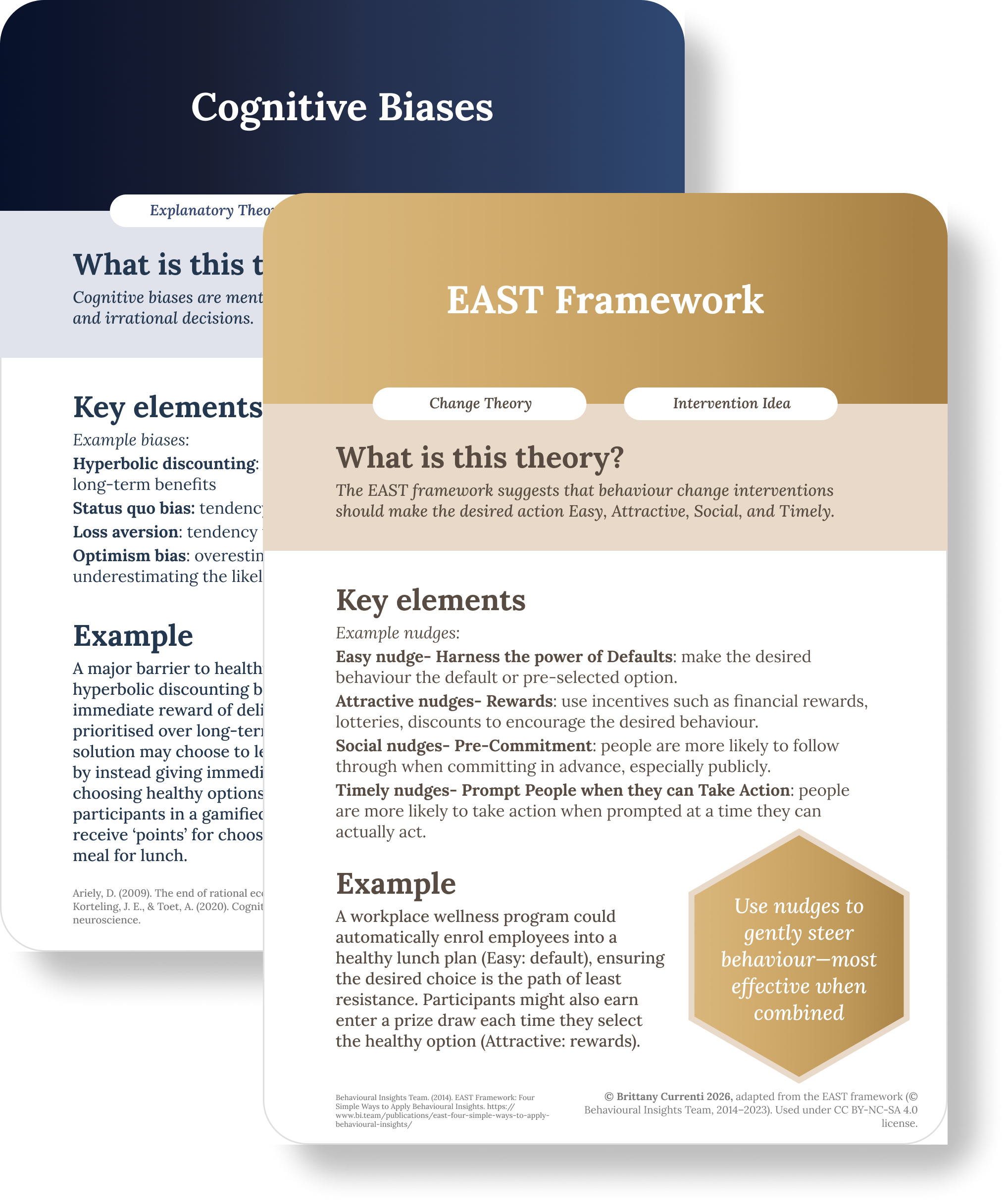
Theory Card Deck
Practitioners may not have a knowledge of theories in their head that they can easily draw from, and performing a literature review is a time-intensive and academic technique. To shortcut this process, I have curated a set of widely applicable behaviour change theories in a simple card deck.
These theories describe the underlying mechanisms explaining why humans behave as they do and are therefore relevant to different problems, audiences, and contexts. Additionally, the theories were chosen for their grounded rather than abstract qualities and their ability to be easily picked up and used. This deck was reviewed by, and received feedback from, 4 behaviour change experts.
The card deck includes clear steps for understanding what the theories are and how to implement them, as well as instructions on which theories to use and when. The deck can be used in combination with the Strategy Sheet, or on its own.
Strategy Sheet
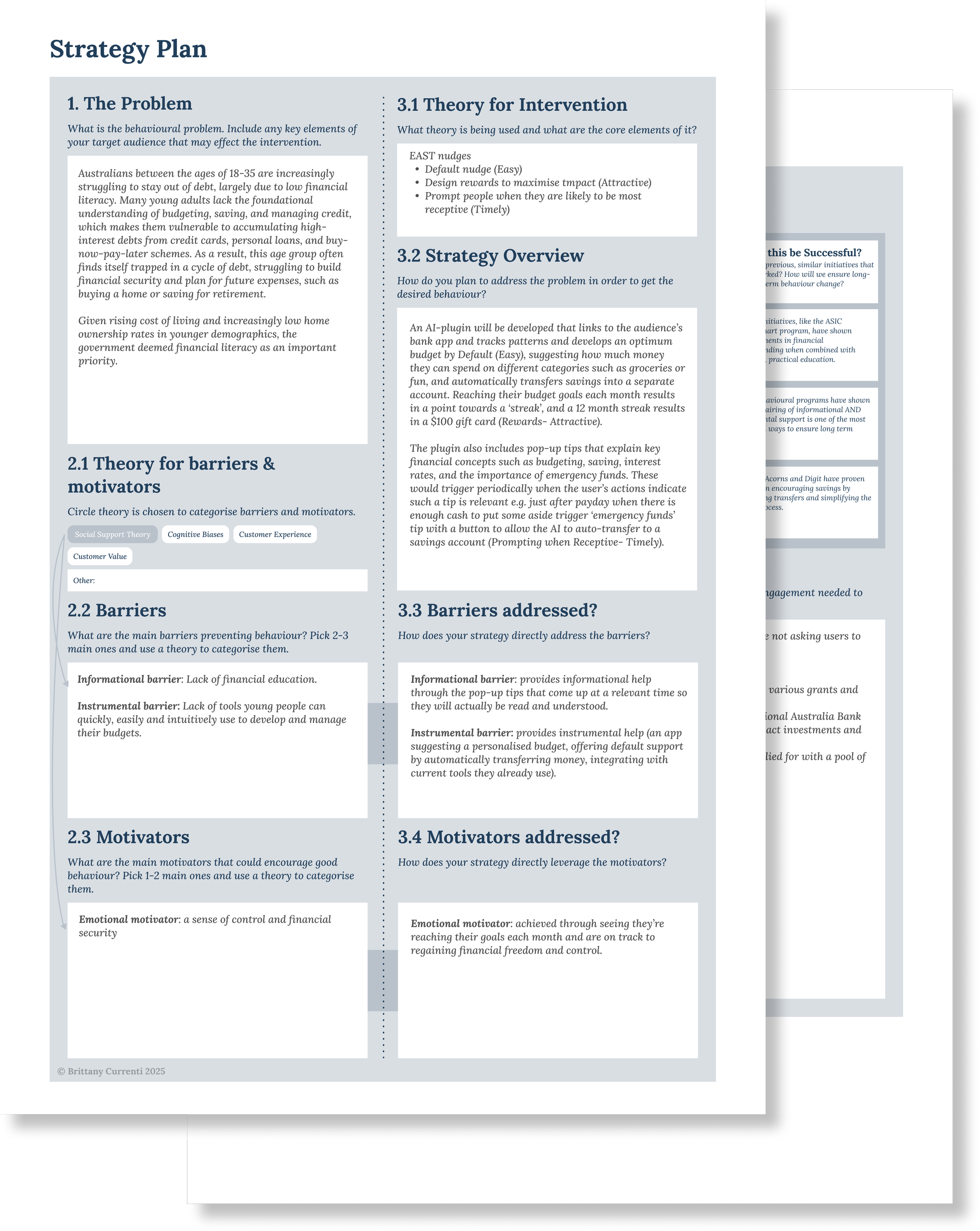
To provide a step-by-step guide on how to implement theory in a behavioural strategy, I have created a strategy sheet to break down the process. The strategy sheet was designed in a pitch style, like that of a case competition or hackathon, with the goal being that practitioners can easily and quickly integrate a theory into a high-level strategy within an hour or so.
Practitioners begin by outlining their problem or goal at a high level and who their target audience is. They then can choose a theory from the card deck that explains why the target audience does not currently perform the behaviour and categorise their barriers. From there, they could either use the same theory or choose a new one to understand how to change behaviour, and ideate their strategy. Practitioners should always ensure they check that their strategy has actually addressed the barriers to change. Finally, the sheet encourages practitioners to set some goals and check the feasibility and viability of their strategy.
Download the free tools here: https://www.brittanycurrenti.com/kit
So do these address the barriers of theory use in practice?
The theory card deck can provide competency support as it provides practitioners with the knowledge of robust and reliable behavioural theories, and explains how these can be implemented.
The strategy sheet can provide material support through its step-by-step guidance on how to implement theory in practice in a hands-on way.
Who are these tools relevant for?
While they were derived from similar assets designed for a university course on social behaviour change, these tools are relevant to anyone who wants to change behaviour. For example:
Social marketers, policy designers, or program managers looking for social change
Brand managers, designers, or product owners who are looking to change consumer behaviour
HR, management, and change officers looking for employee change
University teachers looking for tools to support learning theory
These tools are for anyone looking to bring structure and rigour to their campaigns in an accessible and approachable way.
What now?
I encourage you to apply the free tools outlined in this article to embed behavioural theory into your campaigns. This will help you to reduce risk and ensure that your interventions deliver the meaningful, measurable impact you aim to achieve.
References
Currenti, B. (2026). The know how to implement theory (KIT) framework for practitioner social impact programs. Journal of Social Impact in Business Research, 2(6), 47-63.
Currenti, B. (2025, May 14–15). Risking impact without theory: How practitioners can implement theory in interventions for effective campaigns. Paper presented at the International Social Marketing Conference, Canberra, Australia.
Cook, J., Lynes, J., & Fries, S. (2021). Exploring mistakes and failures in social marketing: The inside story. Social Marketing Quarterly, 27(1), 13-31.
Dietrich, T., Hurley, E., Carins, J., Kassirer, J., Rundle-Thiele, S., Palmatier, R. W., Merritt, R., Weaven, S. K., & Lee, N. (2022). 50 years of social marketing: seeding solutions for the future. European Journal of Marketing, 56(5), 1434-1463.
Department of Human Services. (2022). Social Impact Framework (Version 6). Government of South Australia. https://dhs.sa.gov.au/__data/assets/pdf_file/0010/128557/Social-Impact-Framework_2021_V6.pdf
Mann, C. (2011). Behaviour changing campaigns: Success and failure factors (U4 Expert Helpdesk Report No. 270). U4 Anti-Corruption Resource Centre. https://assets.publishing.service.gov.uk/media/57a08ab140f0b652dd000854/expert-helpdesk-270.pdf
Shove, E., Watson, M., & Pantzar, M. (2012). The dynamics of social practice: Everyday life and how it changes. Nordic Journal of Science and Technology Studies, 1, 41-43.